Wednesday, January 9, 2013

Facts of Casino and Macao Fisherman's Wharf

In recent year, Macao makes great contribution for China tourism. Macao is also famous for its casino. Macao Fisherman's Sharf is the first cultural and themed attractions in Macao and also the must-sees.
1. Casino
Apart from its extremely rich attractions and numerous historical and cultural heritages, Macao is also known as 'Oriental Las Vegas' for its booming and flourishing gambling industry.

Apart from imported casinos like the Venetian Macao, the most renowned and long-standing local casino is the Grand Lisboa started by Gambling King Stanley Ho.
The Casino Grand Lisboa offers an extensive array of exciting casino games with 240 gaming tables and 1000 slot machines. The casino is the first in Macao to offer Texas hold 'em poker and craps.
According to the Macao Laws, youths under 18 years of age are prohibited from entering the casino area. And the most tourists avoid gambling if they have last minute China travel deals in Macao.
2. Macao Fisherman's Wharf
Taking just a 5-minute walk from the Macao-HK Ferry Terminal and Heliport, Macao Fisherman's Wharf is the first cultural and themed attraction in Macao. In addition, it also has dining, shopping, entertainment, accommodation, convention and exhibition facilities in one single location.

Macao Fisherman's Wharf is made up three main sections, including Dynasty Wharf, East Meets West and Legend Wharf. The Dynasty Wharf is home to many traditional Chinese towers in the imitation of the Tang-style. The East Meets West encapsulates oriental traditions and features of western design. The Legend Wharf features a recreational complex, combining shops, hotels, restaurants and a casino.
Travel tips:
How to get there: Take bus no. 1A,3,3A,8,10,10A,10B,17,28A,28B,28BX,28C,32 and get off at Macao Fisherman's Wharf Admission: Free Hours: opens 24 hours
If you have a China business travel, Macao Fisherman's Wharf should not be missed. But as for the casino, you should be prudent to enter.

Tuesday, January 8, 2013

Top Attractions in Inner Mongolia, China

Some people say that sunshine, fresh air and vast forests are one of the biggest draws for modern travelers. Luckily, Inner Mongolia, located in north China, contains all of these features. In addition to the famous Hulun Buir grasslands, there are numerous other impressive scenic and historic attractions located throughout the area for your China travel packages.
1. Mausoleum of Genghis Khan

The Genghis Khan Mausoleum is located in Ordos City. It was built by the Chinese government from 1954 to 1956. Featuring the traditional Mongolian style, the mausoleum is not the real burial place of the Khan because his burial site remains a mystery. It is just a cenotaph, where the coffin contains no body; there are only headdresses and accessories as decorations.
Admission: 110 yuan
Best time to visit: May to September
2. Hulun Buir grasslands

Located in northeastern Inner Mongolia, the Hulun Buir grasslands have been ranked as one of the three best grasslands in the world. The grasslands get their name from the Hulun and Buir lakes. It is one of the world's best preserved grasslands, boasting more than 120 types of pastures. Although every season shows us the different beauty of the grasslands, the landscape from May to August is the most gorgeous as it is dotted with colorful flowers, birds, and cattle and sheep scattered among the grasses. Besides, you can enjoy various kinds of activities, including horseback and camelback riding, and watch the local horse racing and Mongolian wrestling. Hulun Buir grasslands are close to Xinjiang. You can take a Silk Road tour after visiting Inner Mongolia.
Admission: NA
Best time to visit: May to August
3. Xiangshawan

Xiangshawan, also known as the Resonant Sand Gorge, gets its name from an echoing sound you hear when you step on the sands. It is located in the middle part of Dalad Banner near Ordos City. Here, you can enjoy the sand dunes and participate in various kinds of activities like sand surfing and camel riding. It is close to the Mausoleum of Genghis Khan and Zhaojun's Tomb.
Admission: 80 yuan
Best time to visit: Autumn
If you have plan to have last minute China travel deals, you can consider the the attractions in Inner Mongolia.

Monday, January 7, 2013

Most Visited Tourist Cities in China

Thanks to its long history, many scenic spots and superb services as well as accommodations, Beijing, the capital of China, ranked number one on the list of 2012 best city for tourism on Chinese mainland.

China tourism is known as the "Smokeless Industry" or the "Invisible Trade." It is an emerging economic sector which features less investment and big profits. The industry is not only related to beautiful attractions, but also to a large number of services, including transportation, dining, shopping and entertainment.
With China's rapid development, more and more Chinese have taken to traveling on holidays. According to the 2011 data of China National Tourism Administration, the nation had at that time received 135 million inbound tourists and earned US$48.46 billion in foreign exchange revenues, a 1.2% and 5.8% increase respectively compared to 2010. The number of domestic tourists exceeded 2.64 billion and income reached up to 1.9 trillion yuan (US$304.7 billion), increasing 13.2% and 23.6% respectively compared to the 2010 numbers. Tourism has become one of China's fastest growing industries.

According to the report, this year's rankings are based on six tourist criteria, including the inbound tourism number, the domestic tourism number, tourism foreign exchange earnings, domestic tourism income, the number of star hotels and the number of outstanding scenic spots (rated higher than 4A).
Top 1: Beijing
Beijing, the capital of China, is a great city with a history of more than 3,000 years. It's the center of the country's politics, economy, culture and art. As one of China's ancient capitals, Beijing is home to a great number of cultural and historical sites, which make it a huge magnet attracting numerous tourists from all over the world. The top attraction has to be Tian'anmen Square, the world's largest city square and an icon of China. On the north side of the Square lies the 600-year-old Forbidden City, the largest and the best-preserved imperial palace on the planet.

Also, make sure you do not neglect the Summer Palace, the largest and best-preserved royal garden in China. Other top Beijing attractions include the breathtaking Great Wall of China, Temple of Heaven, Temple of Earth, National Stadium and Beijing 798 Art Zone. You can also tour the various traditional hutongs and courtyards to experience the hustle and bustle of local life. All these should be contained in your Beijing tour package.
Top 2: Guangzhou

Guangzhou, also known as Canton, is China's third biggest city. It is famous throughout China and the world for its cuisine and foreign trade. Aside from the endless skyscrapers and shopping malls in this dynamic metropolis, there is a lot of culture and history to see. As one of the twenty-four most famous historical and cultural cities across China, Guangzhou boasts numerous historical relics, including the Bright Filial Piety Temple, the Ancestral Temple of the Chen Family and the Western Han Nanyue King's Tomb Museum. Additionally, the city features a large amount of western style architecture such as the Sacred Heart Cathedral.
Top 3: Shanghai

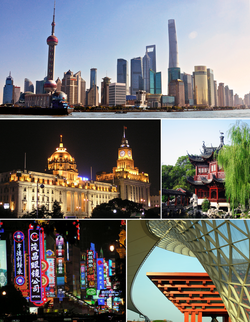
Sitting on the estuary of the Yangtze River, Shanghai is a renowned international metropolis as well as a popular tourist destination. Tourists will marvel at the views in this vibrant land, which perfectly blends traditional with modern elements, as well as eastern with western culture. Famous historical landmarks, including the Bund, the City God Temple and the Yuyuan Garden should not be missed when touring this city. The Bund, a 1.5-kilometer long waterfront area, is noted for dozens of splendid historical buildings in various styles, including Gothic, Baroque, Romanesque, Renaissance, and Neo-Classical which are must-sees for Shanghai tour packages.

Another stunning attraction is the Pudong Skyline, which features a number of mega skyscrapers including the symbolic Oriental Pearl Tower, the Jin Mao Tower, the Shanghai World Financial Center and the presently-under-construction 632-meter Shanghai Tower. Tourists will also be enthralled to go to the Memorial Site for the First National Congress of the CPC, Shanghai Xintiandi (New Heaven and Earth), and the premier shopping street-Nanjing Road.

Sunday, January 6, 2013

What to See in Gansu, China

Located in the northwest of China, Gansu formed the golden intersection on the Ancient Silk Road and is one of the birthplaces of the Chinese nation. This wealth in cultural heritage left Gansu with numerous uncommon touristic assets. The province boasts an abundance of natural attractions as well as of cultural relics. The amazing Yueya Spring and world famous Mogao Grottoes are merely two illustrations of this magical place's legendary beauty! Gansu is a destination included in Silk Road tours. The following top attractions should not be missed.
1. Mogao Grottoes

Located on the eastern slopes of the Mingsha Mountain in the southeast of Dunhuang County in Gansu Province, the Mogao Grottoes are one of three best noted grottoes in China and also contain the largest, best preserved and richest treasure house of Buddhist art in the whole world. Also known as the Thousand Buddha Cave, a monk named Yue Seng chiseled the first cave here in 366, during the Eastern Jin Dynasty (317-420). The endeavor was continued by later dynasties, up until the Yuan Dynasty (1279-1368), resulting in the fantastic group of caves that can still be seen today. Today, 492 caves have stood the test of time and contain some 2,100 colored statues and 45,000 square meters of murals. If you join China tour packages to Gansu, Mogao Grottos should not miss.
Admission: 160 yuan (Chinese),180 yuan (foreigners) (Apr 1 - Oct 31); 80 yuan - 120 yuan (Nov 1 - Mar 31)
Best time to visit: Summer and autumn
2. Yueya Spring

Located in Dunhuang City, the Mingsha Mountain and Yueya Spring Scenic Spot has been one of the eight most famous scenic spots in Dunhuang since the Han Dynasty (202 BC–220 AD). The Yueya Spring, also known as the Crescent Moon Spring, is surrounded by the Mingsha Mountains. It stretches for 100 m from South to North, and 25m from East to West. The Yueya Spring has been a scenic wonder for a long time and is reputed to be the "First Spring in Sand". Mingsha Mountain, also known as the "Echoing-Sand Mountain" got its name from the sound-making sands surrounding it. Additionally, it features plenty of leisurely activities, including sand surfing, camel riding and visits to the sand spa.

Admission: 120 yuan (Apr 1 - Oct 31), 80 yuan (Nov 1 - Mar 31)
Best time to visit: Summer and autumn
If you want to know more info about Gansu attractions, you can contact with China tour agents.

Saturday, January 5, 2013

Top Attractions in Fujian

1. Gulangyu Island
Located 600 meters to the southwest of Xiamen City, Gulangyu Island, or Drum Wave Islet which is always contained in the China travel packages, is an extremely beautiful island, nicknamed the "garden on the sea." Covering an area of 1.87 square kilometers (187 hectares), this small island is flooded by green trees and lovely flowers. Among the many scenic spots on the island, the most attractive ones are the Sunlight Rock and the Shuzhuang Garden.

The island is home to about 20,000 permanent residents, all of whom enjoy a comfortable and relaxed lifestyle. Only electric-powered vehicles are permitted on the island, so the environment is free from the noise and pollution of car engines.
The island was previously called Yuanshazhou Island and got its present name during the Ming Dynasty (1368-1644), because when the tide comes in, the waves pound the reef which sounds like the beating of a drum.
With the best of classical and romantic European-style architecture, the island truly deserves to be called a "museum of architecture." It is also known as the 'Cradle of Musicians' and 'Island of Music' because of its appreciation for music and the popularity of the piano.
Admission: 100 yuan(US$15.73)/person
2. Mount Wuyi
Located on the junction of Fujian and Jiangxi, Mount Wuyi is a famous scenic spot bearing red cliffs, lofty peaks, a deep and secluded valley, caves and fantastic rock peaks. Covering an area of 60 square kilometers (6,000 hectares), it is the most outstanding biodiversity conservation zone in the southeastern part of China.
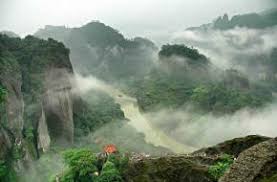
Most of the hills here are made of red sandstones, rise steeply but are flat on the top. The peaks and rocks of grotesque shapes are girded by clear streams and embraced by green trees and bamboo plants. The Nine-bend River, 60 kilometers (37.28 miles) long, meanders among the hills, presenting the most charming tourist route within this scenic zone.
Mount Wuyi has a long cultural history. The site of the Wuyi Palace, built in the seventh century for emperors to conduct sacrificial activities, remains until this day. It had been an important center of China's Taoism and was listed as one of the top nine Taoist Temples in the 10th century. The mountain also boasts many other cultural relics, including stone inscriptions.
In 1999, Mount Wuyi entered the UNESCO list of World Heritage Sites, both on a natural and cultural level. Mount Wuyi should not missed for your tailor-made China tours
Admission: 140 yuan(US$22.02)/person
3. Three Lanes and Seven Alleys
Located in the downtown area of Fuzhou, Fujian's capital city, the Three Lanes and Seven Alleys (Sanfang-Qixiang) is a street district featuring a cluster of ancient residential buildings and is the largest well-preserved historical heritage site in China, covering an area of 40 hectares.

With the Southern Street acting as their central axis, the original three lanes were in the west and the seven alleys are in the east. The layout dates back to the Tang (618-907) and Song (960-1279) dynasties, almost 1,000 years ago. The street is unique as it is the only existing street district in China bearing this pattern. Running from north to south, the lanes refer to Wenru Lane, Yijin Lane, and Guanglu Lane, whereas the alleys refer to Huang Alley, Gong Alley, Yangqiao Alley, Langguan Alley, Ta Alley, Anmin Alley, and Jipi Alley.
The lanes and alleys were home to hundreds of houses constructed by wealthy people of the Ming and Qing dynasties, and 159 buildings remain well-preserved to this day. As a result, the district has been nicknamed "an architectural museum of the Ming and Qing dynasties." The houses were built using huge old bricks and they carry seashell decorations-which were easy to get because of Fuzhou's coastal location. The ornaments, wood carvings and stone carvings all testify to the past glory of the area and its buildings.
The area has been home to many famous people, including politicians, military leaders, writers and poets. Some of their descendants still reside there today, keeping up the living fashions of their ancestors. Jiqi Alley, Yangqiao Alley and Guanglu Lane have now been converted into driveways. Only two lanes and five alleys remain.
Admission: Free
If you visit these attractions in Fujian and experience the essence of these places, you can totally feel the difference from that of Guilin tour.

Friday, January 4, 2013

temples in China to pray in Spring Festival

Spring Festival is almost here! According to tradition, burning incense and offering prayers in a temple at this time of year will bring you good luck for the whole year. So, whether you believe this or not, why not take a culturally exhilarating temple tour with your family over the holidays? Who knows, it may just make your Year of the Snake roar. The following offers you the top temples for your lucky and popular China tours.
1. Yonghe Temple, Beijing

Yonghe Temple, situated in the northeast part of downtown Beijing, is the largest and best-preserved lamasery in Beijing and one of the most important lama temples in the world. It was built in 1694 during the Qing Dynasty (1644-1911) as the residence of the Emperor Yongzheng before he ascended the throne. During the 9th year of Emperor Qian Long's reign (1744), the residence was completely converted into a lamasery. As a famous site of the Lama Buddhist sect, the temple attracts many pilgrims and travelers every day. Based on the belief that incense offerings should be made as early as possible to improve one's luck for the coming year, thousands of worshippers congregate outside the temple on Chinese New Year's Eve waiting to rush inside on the stroke of midnight. Yonghe Temple is a must-see destination for Beijing tours.
Travel tips:
Admission: 25 yuan, 12 yuan for students
Opening Hours: 09:00 --17:00
Getting there: Take Buses No. 13, 62, 116, 117, 684, or take subway Line 2 or 5 to Yonghegong Lama Temple Station, Exit C.
2. Wutai Mountain, Shanxi

Standing at the northeast part of Shanxi Province, Wutai Mountain, along with Emei Mountain in Sichuan, Putuo Mountain in Zhejiang, and Jiuhua Mountain in Anhui, is one of the four sacred mountains in Chinese Buddhism. As the dojo of the Bodhisattva Manjusri, the Bodhisattva of wisdom, the mountain is famous not only in China, but also in Japan, India, Nepal and other neighboring countries. Thousands of students and their parents flock to Wutai to pray for good luck and a bright future during the pre-exam season, especially before the National College Entrance Examination.
Travel tips:
Admission: 168 yuan (Apr. --Oct.), 145 yuan (Nov. --Mar.)
Opening hours: 6:30 -- 20:00
Getting there: Take long-distance buses from Yingze Street in Taiyuan, Xinzhou City or Wutai County.
If you want to plan AFFORDABLE china packages to pray for Spring Festival, the above-mentioned attractions should not missed.

The traditional way of celebrating Spring Festival in Qikou, Shanxi

At Shanxi's Qikou township, the roaring Yellow River, accompanied by the cracking of ice, thrills you with the best of nature for your educational China tours.

The Qikou township is a remote town along the Yellow River in Shanxi's Linxian county. Its location at the boundary of Shanxi and Shaanxi provinces gives it the rich culture and characteristics of both the places.
At Qikou, you can watch the ice floating along the Yellow River during the Spring Festival. The Yellow River looks like a huge snake that is casting off its skin. The ice cracks and rumbles like a rock concert on the river.
You can hide in one corner and daydream, or you can sit on heated adobe bed and learn to make cloth tiger and paper-cut decorations from local villagers.
If you want to customize China tours in Shanxi during Spring Festival, you should consider Qikou, Shanxi.